Understanding Modern AI Engineering Disciplines
Introduction
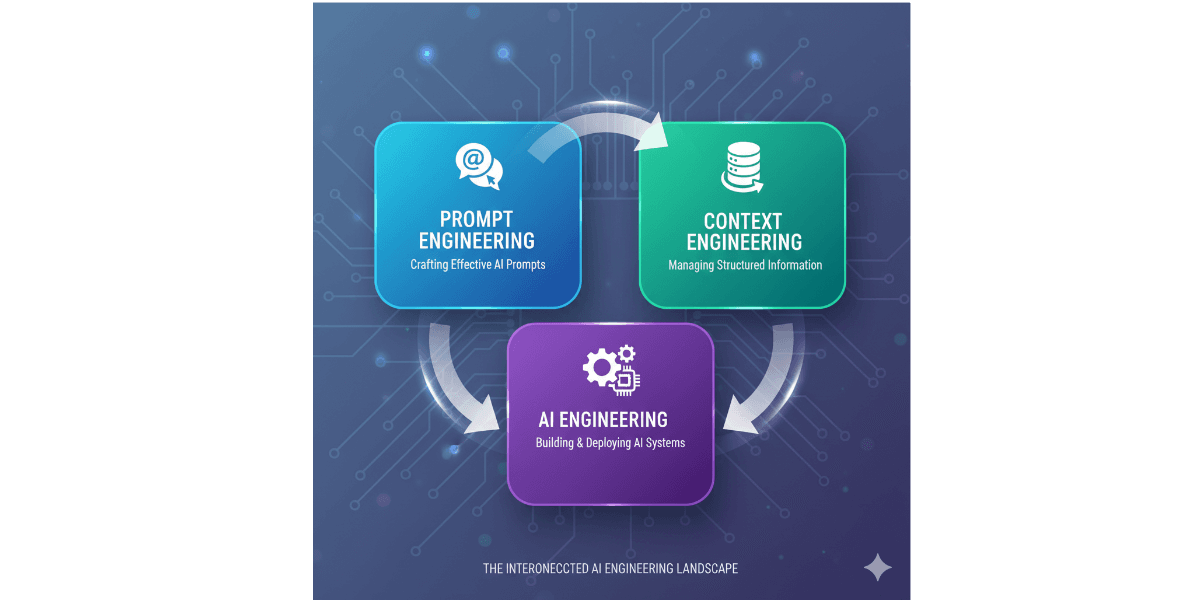
The rapid evolution of artificial intelligence has given rise to several specialized engineering disciplines, each focusing on different aspects of building and optimizing AI systems. Three key disciplines have emerged: Prompt Engineering, AI Engineering, and Context Engineering. While distinct, these fields are deeply interconnected and often work in tandem to create effective AI solutions.
Prompt Engineering
Definition
Prompt Engineering is the practice of designing, refining, and optimizing input prompts to elicit desired responses from large language models (LLMs) and other AI systems. It involves crafting instructions, questions, or statements that guide AI models to produce accurate, relevant, and useful outputs.
Key Features
- Iterative Refinement: Continuously testing and improving prompts based on model outputs
- Technique Application: Utilizing methods like few-shot learning, chain-of-thought prompting, and role-playing
- Specificity and Clarity: Crafting precise instructions that minimize ambiguity
- Output Control: Formatting requests to achieve desired response structure and style
- Context Injection: Including relevant background information within prompts
AI Engineering
Definition
AI Engineering is a broad discipline encompassing the design, development, deployment, and maintenance of AI systems and applications. It combines software engineering principles with machine learning expertise to build production-ready AI solutions.
Key Features
- System Architecture: Designing scalable and robust AI system architectures
- Model Integration: Incorporating AI models into larger software systems
- Performance Optimization: Ensuring efficiency, speed, and resource management
- MLOps Practices: Implementing continuous integration/deployment for AI models
- Infrastructure Management: Setting up and maintaining the technical stack for AI applications
- Quality Assurance: Testing, monitoring, and maintaining AI system reliability
Context Engineering
Definition
Context Engineering is the discipline of managing, structuring, and optimizing the contextual information provided to AI systems to improve their understanding and response quality. It focuses on how information is organized, retrieved, and presented to models to maximize relevance and accuracy.
Key Features
- Information Retrieval: Implementing systems to fetch relevant data (RAG - Retrieval Augmented Generation)
- Context Window Management: Optimizing limited context space in AI models
- Memory Systems: Building short-term and long-term memory for AI applications
- Context Hierarchization: Prioritizing and structuring information by relevance
- Dynamic Context Assembly: Adaptively selecting and formatting contextual data
- Knowledge Base Design: Creating and maintaining structured information repositories
The Relationships Between the Disciplines
Prompt Engineering ↔ Context Engineering
- Interdependence: Effective prompts often rely on well-engineered context, while context engineering must understand how prompts will utilize the provided information
- Optimization: Context engineers provide the raw material that prompt engineers craft into effective instructions
- Feedback Loop: Prompt engineering insights inform context engineering strategies
AI Engineering ↔ Prompt Engineering
- Implementation: AI engineers build systems that execute prompt engineering strategies at scale
- Tool Development: AI engineers create frameworks and tools that facilitate prompt engineering
- Production Deployment: AI engineers operationalize prompt engineering techniques
AI Engineering ↔ Context Engineering
- Infrastructure: AI engineers build the technical infrastructure for context retrieval and management
- System Integration: Context engineering components must be integrated into broader AI systems by AI engineers
- Performance: AI engineers optimize the performance of context engineering systems
The Unified Workflow
In practice, these disciplines form an integrated workflow:
- Context Engineering gathers and structures relevant information
- Prompt Engineering crafts effective instructions using that context
- AI Engineering builds the systems that orchestrate these components at scale
Conclusion
While Prompt Engineering, AI Engineering, and Context Engineering are distinct disciplines with unique focuses, they are fundamentally interconnected. Successful AI applications require expertise across all three areas. Prompt engineers need to understand context management, context engineers must consider how their work enables effective prompting, and AI engineers must build systems that support both disciplines. As AI technology continues to evolve, the boundaries between these fields may blur, but their core principles will remain essential to building effective AI solutions.
Reference Sources
-
OpenAI - Prompt Engineering Guide https://platform.openai.com/docs/guides/prompt-engineering
-
Anthropic - Prompt Engineering Overview https://docs.anthropic.com/claude/docs/prompt-engineering
-
Microsoft - Azure OpenAI Prompt Engineering Best Practices https://learn.microsoft.com/en-us/azure/ai-services/openai/concepts/prompt-engineering
-
LangChain Documentation - Context and Memory https://python.langchain.com/docs/modules/memory/
-
Google Cloud - MLOps and AI Engineering https://cloud.google.com/architecture/mlops-continuous-delivery-and-automation-pipelines-in-machine-learning
-
Pinecone - Vector Databases and Context Engineering https://www.pinecone.io/learn/vector-database/
-
Chip Huyen - Building LLM Applications for Production https://huyenchip.com/2023/04/11/llm-engineering.html
-
Elvis Saravia et al. - Prompt Engineering Guide (GitHub) https://github.com/dair-ai/Prompt-Engineering-Guide
-
Stanford CS324 - Large Language Models https://stanford-cs324.github.io/winter2022/
-
Retrieval Augmented Generation (RAG) - Research Paper https://arxiv.org/abs/2005.11401