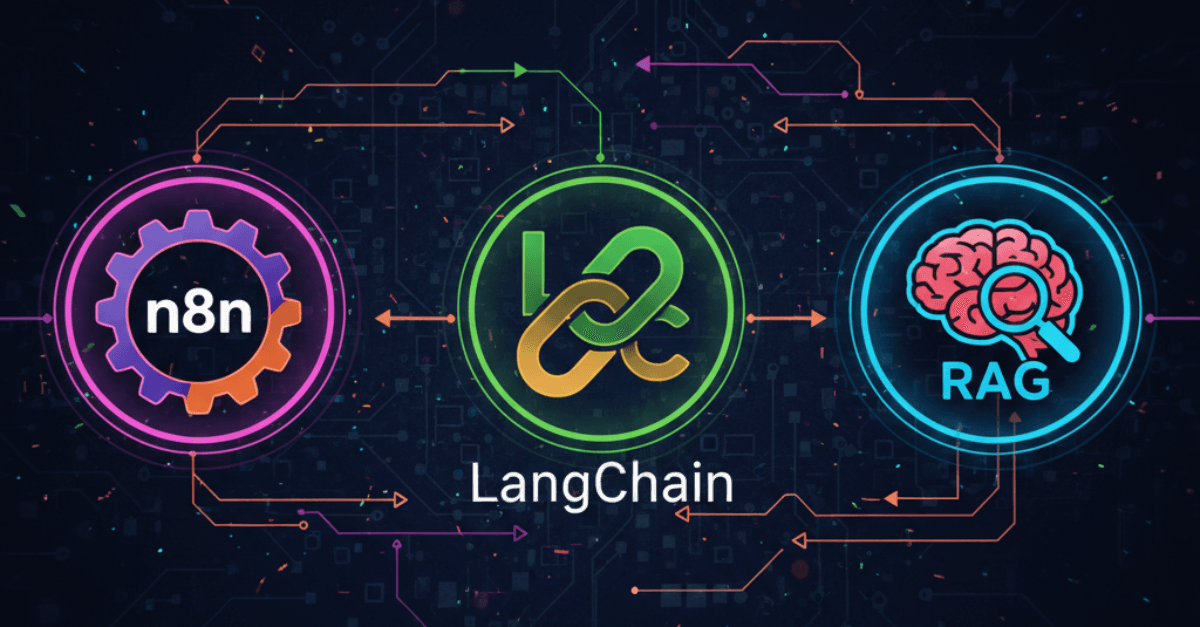
n8n, LangChain, and RAG: A Developer's Guide
Table of Contents
- Introduction
- n8n - Workflow Automation
- LangChain - LLM Application Framework
- RAG - Retrieval-Augmented Generation
- Integration Patterns
- Real-World Implementation Examples
- Best Practices
- Common Pitfalls and Solutions
Introduction
This guide provides a comprehensive understanding of three powerful technologies that, when combined, can create sophisticated AI-powered automation systems. Whether you're building intelligent chatbots, automated content pipelines, or knowledge management systems, understanding these tools and their relationships is crucial.
Why These Technologies Matter
- n8n: Eliminates manual processes and connects disparate systems
- LangChain: Makes LLM integration accessible and manageable
- RAG: Ensures AI responses are accurate, relevant, and grounded in facts
n8n - Workflow Automation
What is n8n?
n8n (pronounced "nodemation") is an open-source workflow automation platform that enables you to connect anything to everything. Think of it as a visual programming environment for APIs and services.
Core Concepts
1. Nodes
Individual building blocks that perform specific actions:
// Example: HTTP Request Node Configuration
{
  "method": "POST",
  "url": "https://api.example.com/data",
  "authentication": "bearer",
  "headers": {
    "Content-Type": "application/json"
  }
}
2. Workflows
Sequences of connected nodes that execute in order:
- Trigger Nodes: Start workflows (webhooks, schedules, manual triggers)
- Action Nodes: Perform operations (HTTP requests, database queries, transformations)
- Logic Nodes: Control flow (IF conditions, loops, merge operations)
3. Expressions
Dynamic values using JavaScript-like syntax:
// Access previous node's data
{{ $node["HTTP Request"].json.userId }}

// Use built-in functions
{{ $now.format('yyyy-MM-dd') }}

// Conditional logic
{{ $json.status === 'active' ? 'Process' : 'Skip' }}
Real-World Example: E-commerce Order Processing
Workflow: Order Processing Automation
Triggers:
  - Webhook from Shopify (new order)

Steps:
  1. Validate order data
  2. Check inventory in PostgreSQL
  3. Send to fulfillment center API
  4. Update CRM (Salesforce)
  5. Send confirmation email (SendGrid)
  6. Post to Slack channel
  7. Generate invoice PDF
  8. Upload to Google Drive
n8n Best Practices
- Error Handling
// Always implement error workflows
{
  "errorWorkflow": "workflow_error_handler_id",
  "continueOnFail": false,
  "retry": {
    "maxRetries": 3,
    "waitBetweenRetries": 5000
  }
}
- Use Environment Variables
# .env file
API_KEY=your-secure-key
DATABASE_URL=postgresql://...
- Modular Workflows
- Break complex workflows into sub-workflows
- Use the "Execute Workflow" node for reusability
LangChain - LLM Application Framework
What is LangChain?
LangChain is a framework designed to simplify the creation of applications using large language models. It provides abstractions for common patterns in LLM development.
Core Components
1. Models
Interface with various LLMs:
from langchain.llms import OpenAI, Anthropic, HuggingFace

# OpenAI GPT
llm = OpenAI(
    temperature=0.7,
    model="gpt-4",
    max_tokens=1000
)

# Anthropic Claude
llm = Anthropic(
    model="claude-3-sonnet",
    temperature=0.5
)
2. Prompts
Structured prompt templates:
from langchain.prompts import PromptTemplate

template = """
You are a {role} assistant for {company}.
Context: {context}
Question: {question}
Answer in {tone} tone:
"""

prompt = PromptTemplate(
    input_variables=["role", "company", "context", "question", "tone"],
    template=template
)
3. Chains
Combine components into sequences:
from langchain.chains import LLMChain, SimpleSequentialChain

# Single chain
chain = LLMChain(llm=llm, prompt=prompt)

# Sequential chains
analysis_chain = LLMChain(llm=llm, prompt=analysis_prompt)
summary_chain = LLMChain(llm=llm, prompt=summary_prompt)

overall_chain = SimpleSequentialChain(
    chains=[analysis_chain, summary_chain]
)
4. Memory
Maintain conversation context:
from langchain.memory import ConversationBufferMemory

memory = ConversationBufferMemory(
    memory_key="chat_history",
    return_messages=True
)

conversation = ConversationChain(
    llm=llm,
    memory=memory,
    verbose=True
)
5. Agents
Autonomous decision-making:
from langchain.agents import create_sql_agent
from langchain.agents.agent_toolkits import SQLDatabaseToolkit

toolkit = SQLDatabaseToolkit(db=db, llm=llm)
agent = create_sql_agent(
    llm=llm,
    toolkit=toolkit,
    verbose=True,
    agent_type=AgentType.ZERO_SHOT_REACT_DESCRIPTION
)

# Agent can now answer questions about your database
result = agent.run("What were the top 5 selling products last month?")
Real-World Example: Customer Support Chatbot
# Complete implementation
class CustomerSupportBot:
    def __init__(self):
        self.llm = OpenAI(temperature=0.3)

        # Knowledge base loader
        self.loader = DirectoryLoader(
            'support_docs/',
            glob="**/*.md"
        )

        # Vector store for similarity search
        self.vectorstore = Chroma.from_documents(
            documents=self.loader.load(),
            embedding=OpenAIEmbeddings()
        )

        # QA chain with retrieval
        self.qa_chain = RetrievalQA.from_chain_type(
            llm=self.llm,
            retriever=self.vectorstore.as_retriever(),
            return_source_documents=True
        )

    def answer_question(self, question):
        result = self.qa_chain({"query": question})
        return {
            "answer": result["result"],
            "sources": result["source_documents"]
        }
LangChain Best Practices
- Token Management
# Monitor token usage
from langchain.callbacks import get_openai_callback

with get_openai_callback() as cb:
    result = llm("What is the meaning of life?")
    print(f"Tokens used: {cb.total_tokens}")
    print(f"Cost: ${cb.total_cost}")
- Caching Strategies
from langchain.cache import InMemoryCache
import langchain

# Enable caching
langchain.llm_cache = InMemoryCache()
- Error Recovery
from tenacity import retry, stop_after_attempt, wait_exponential

@retry(
    stop=stop_after_attempt(3),
    wait=wait_exponential(multiplier=1, min=4, max=60)
)
def safe_llm_call(prompt):
    return llm(prompt)
RAG - Retrieval-Augmented Generation
What is RAG?
RAG combines the power of retrieval systems with generative AI models. Instead of relying solely on the model's training data, RAG fetches relevant information from a knowledge base to generate more accurate, contextual responses.
How RAG Works
graph LR
    A[User Query] --> B[Embedding Model]
    B --> C[Vector Search]
    C --> D[Knowledge Base]
    D --> E[Relevant Documents]
    E --> F[Context + Query]
    F --> G[LLM]
    G --> H[Generated Response]
Components of a RAG System
1. Document Ingestion
# Load various document types
from langchain.document_loaders import (
    PDFLoader,
    TextLoader,
    CSVLoader,
    UnstructuredMarkdownLoader,
    WebBaseLoader
)

# Example: Loading multiple sources
loaders = [
    PDFLoader("manual.pdf"),
    TextLoader("faq.txt"),
    WebBaseLoader("https://docs.example.com"),
    CSVLoader("products.csv")
]

documents = []
for loader in loaders:
    documents.extend(loader.load())
2. Text Splitting
from langchain.text_splitter import RecursiveCharacterTextSplitter

text_splitter = RecursiveCharacterTextSplitter(
    chunk_size=1000,
    chunk_overlap=200,
    length_function=len,
    separators=["\n\n", "\n", " ", ""]
)

chunks = text_splitter.split_documents(documents)
3. Embedding and Storage
from langchain.embeddings import OpenAIEmbeddings
from langchain.vectorstores import Pinecone, Chroma, Weaviate

# Create embeddings
embeddings = OpenAIEmbeddings()

# Store in vector database
vectorstore = Chroma.from_documents(
    documents=chunks,
    embedding=embeddings,
    persist_directory="./chroma_db"
)

# Or use Pinecone for production
import pinecone
pinecone.init(api_key="your-key", environment="your-env")
vectorstore = Pinecone.from_documents(
    chunks,
    embeddings,
    index_name="knowledge-base"
)
4. Retrieval Strategies
# Similarity search
retriever = vectorstore.as_retriever(
    search_type="similarity",
    search_kwargs={"k": 5}
)

# MMR (Maximum Marginal Relevance) for diversity
retriever = vectorstore.as_retriever(
    search_type="mmr",
    search_kwargs={"k": 5, "lambda_mult": 0.5}
)

# Hybrid search (combining keyword and semantic)
from langchain.retrievers import EnsembleRetriever
from langchain.retrievers import BM25Retriever

bm25_retriever = BM25Retriever.from_documents(chunks)
ensemble_retriever = EnsembleRetriever(
    retrievers=[bm25_retriever, retriever],
    weights=[0.3, 0.7]
)
Real-World Example: Technical Documentation Assistant
class TechnicalDocsRAG:
    def __init__(self, docs_path):
        # 1. Load documentation
        self.loader = DirectoryLoader(
            docs_path,
            glob="**/*.md",
            loader_cls=UnstructuredMarkdownLoader
        )

        # 2. Process documents
        self.text_splitter = RecursiveCharacterTextSplitter(
            chunk_size=1500,
            chunk_overlap=300,
            separators=["\n## ", "\n### ", "\n\n", "\n", " "]
        )

        # 3. Create vector store with metadata
        docs = self.loader.load()
        chunks = self.text_splitter.split_documents(docs)

        # Add metadata
        for chunk in chunks:
            chunk.metadata["source_type"] = "documentation"
            chunk.metadata["indexed_at"] = datetime.now()

        self.vectorstore = Chroma.from_documents(
            chunks,
            OpenAIEmbeddings(),
            persist_directory="./tech_docs_db"
        )

        # 4. Setup QA chain
        self.qa_chain = RetrievalQA.from_chain_type(
            llm=ChatOpenAI(temperature=0, model="gpt-4"),
            retriever=self.vectorstore.as_retriever(
                search_kwargs={"k": 4}
            ),
            chain_type="stuff",
            return_source_documents=True
        )

    def answer_technical_question(self, question):
        # Add context to improve retrieval
        enhanced_query = f"""
        Technical Question: {question}
        Please provide a detailed technical answer with code examples if applicable.
        """

        result = self.qa_chain({"query": enhanced_query})

        return {
            "answer": result["result"],
            "sources": [doc.metadata["source"] for doc in result["source_documents"]],
            "confidence": self._calculate_confidence(result)
        }

    def _calculate_confidence(self, result):
        # Simple confidence based on source relevance
        if len(result["source_documents"]) >= 3:
            return "High"
        elif len(result["source_documents"]) >= 1:
            return "Medium"
        return "Low"
RAG Best Practices
- Chunking Strategy
# Domain-specific chunking
def smart_chunk_documents(docs, doc_type):
    if doc_type == "code":
        return CodeTextSplitter(
            language="python",
            chunk_size=500
        ).split_documents(docs)
    elif doc_type == "markdown":
        return MarkdownHeaderTextSplitter(
            headers_to_split_on=[
                ("#", "Header 1"),
                ("##", "Header 2"),
            ]
        ).split_documents(docs)
    else:
        return RecursiveCharacterTextSplitter(
            chunk_size=1000
        ).split_documents(docs)
- Metadata Enrichment
# Add rich metadata for better filtering
for doc in documents:
    doc.metadata.update({
        "date_processed": datetime.now(),
        "version": "1.0",
        "department": "engineering",
        "access_level": "public",
        "language": "en"
    })
- Hybrid Retrieval
# Combine multiple retrieval methods
class HybridRetriever:
    def __init__(self, vectorstore, keyword_index):
        self.vector_retriever = vectorstore.as_retriever()
        self.keyword_retriever = keyword_index.as_retriever()

    def retrieve(self, query, k=5):
        vector_results = self.vector_retriever.get_relevant_documents(query)
        keyword_results = self.keyword_retriever.get_relevant_documents(query)

        # Merge and deduplicate
        all_docs = vector_results + keyword_results
        unique_docs = {doc.page_content: doc for doc in all_docs}

        return list(unique_docs.values())[:k]
Integration Patterns
Pattern 1: n8n + LangChain
Use Case: Automated Content Generation Pipeline
n8n Workflow:
  1. RSS Feed Trigger (new blog post detected)
  2. HTTP Request (fetch full article)
  3. LangChain Node:
     - Summarize article
     - Generate social media posts
     - Extract key points
  4. Twitter API (post summary)
  5. LinkedIn API (post professional version)
  6. Slack (notify team)
Implementation:
// n8n Custom Node calling LangChain
const langchainEndpoint = 'http://langchain-api:8000/generate';

const response = await this.helpers.httpRequest({
  method: 'POST',
  url: langchainEndpoint,
  body: {
    task: 'summarize',
    content: $node["RSS Feed"].json.content,
    style: 'professional',
    max_length: 280
  }
});

return [{
  json: {
    summary: response.summary,
    hashtags: response.hashtags,
    sentiment: response.sentiment
  }
}];
Pattern 2: LangChain + RAG
Use Case: Intelligent Customer Support System
class SupportSystem:
    def __init__(self):
        # Setup RAG
        self.knowledge_base = self._load_knowledge_base()
        self.retriever = self.knowledge_base.as_retriever()

        # Setup conversation chain with RAG
        self.chain = ConversationalRetrievalChain.from_llm(
            llm=ChatOpenAI(temperature=0.3),
            retriever=self.retriever,
            memory=ConversationBufferMemory(
                memory_key="chat_history",
                return_messages=True
            )
        )

    def handle_support_ticket(self, ticket):
        # 1. Classify intent
        intent = self._classify_intent(ticket.message)

        # 2. Retrieve relevant docs
        context = self.retriever.get_relevant_documents(
            ticket.message
        )

        # 3. Generate response
        response = self.chain({
            "question": ticket.message,
            "chat_history": ticket.history
        })

        # 4. Check if escalation needed
        if self._needs_human_review(response):
            return self._escalate_to_human(ticket, response)

        return response
Pattern 3: n8n + RAG + LangChain
Use Case: Automated Documentation Update System
graph TD
    A[GitHub Webhook] -->|Code Change| B[n8n Workflow]
    B --> C[Extract Changes]
    C --> D[RAG System]
    D -->|Find Related Docs| E[LangChain]
    E -->|Update Documentation| F[Generate PR]
    F --> G[Notify Team]
Implementation:
# LangChain service called by n8n
@app.post("/update-docs")
async def update_documentation(request: UpdateRequest):
    # 1. RAG: Find affected documentation
    affected_docs = rag_system.find_related_docs(
        request.changed_files
    )

    # 2. LangChain: Generate updates
    updates = []
    for doc in affected_docs:
        update = await generate_doc_update(
            original_doc=doc,
            code_changes=request.changes,
            style_guide=load_style_guide()
        )
        updates.append(update)

    # 3. Create pull request
    pr_url = create_github_pr(updates)

    return {
        "status": "success",
        "pr_url": pr_url,
        "docs_updated": len(updates)
    }
Real-World Implementation Examples
Example 1: E-Learning Platform with AI Tutor
Architecture:
Student Question → n8n → RAG (Course Materials) → LangChain (Personalized Response) → Student
Implementation:
class AITutor:
    def __init__(self):
        # Load course materials into RAG
        self.course_vectorstore = self._load_course_materials()

        # Setup personalization
        self.student_profiles = {}

        # LangChain with custom prompts
        self.tutor_chain = self._setup_tutor_chain()

    def answer_student_question(self, student_id, question):
        # 1. Get student profile
        profile = self.student_profiles.get(student_id, {})

        # 2. Retrieve relevant course materials
        materials = self.course_vectorstore.similarity_search(
            question,
            k=3,
            filter={"difficulty": profile.get("level", "beginner")}
        )

        # 3. Generate personalized response
        response = self.tutor_chain.run(
            question=question,
            materials=materials,
            learning_style=profile.get("learning_style", "visual"),
            previous_topics=profile.get("completed_topics", [])
        )

        # 4. Update student profile
        self._update_student_progress(student_id, question, response)

        return response
Example 2: Legal Document Analysis System
Components:
- n8n: Orchestrates document intake and workflow
- RAG: Searches legal precedents and regulations
- LangChain: Analyzes and summarizes findings
class LegalAnalyzer:
    def __init__(self):
        # Specialized legal embeddings
        self.embeddings = LegalBERT()

        # Multiple vector stores for different document types
        self.precedents_store = Pinecone(
            index="legal-precedents",
            embedding=self.embeddings
        )
        self.regulations_store = Pinecone(
            index="regulations",
            embedding=self.embeddings
        )

        # Chain for legal analysis
        self.analysis_chain = self._create_legal_chain()

    def analyze_case(self, case_details):
        # 1. Extract key legal issues
        issues = self._extract_legal_issues(case_details)

        # 2. Search precedents for each issue
        relevant_cases = {}
        for issue in issues:
            relevant_cases[issue] = self.precedents_store.similarity_search(
                issue,
                k=10,
                filter={"jurisdiction": case_details["jurisdiction"]}
            )

        # 3. Search applicable regulations
        regulations = self.regulations_store.similarity_search(
            case_details["summary"],
            k=5
        )

        # 4. Generate comprehensive analysis
        analysis = self.analysis_chain.run(
            case=case_details,
            precedents=relevant_cases,
            regulations=regulations,
            output_format="legal_memo"
        )

        return {
            "analysis": analysis,
            "cited_cases": self._extract_citations(relevant_cases),
            "applicable_laws": self._extract_law_references(regulations),
            "confidence_score": self._calculate_confidence(analysis)
        }
Example 3: Multi-Language Customer Service Bot
Features:
- Automatic language detection
- Cultural context awareness
- Multi-lingual knowledge base
class MultilingualSupportBot:
    def __init__(self):
        # Language-specific vector stores
        self.vector_stores = {
            "en": Chroma(collection_name="support_en"),
            "es": Chroma(collection_name="support_es"),
            "fr": Chroma(collection_name="support_fr"),
            "de": Chroma(collection_name="support_de")
        }

        # Language models
        self.llms = {
            "en": ChatOpenAI(model="gpt-4"),
            "es": ChatOpenAI(model="gpt-4", temperature=0.4),
            "fr": ChatOpenAI(model="gpt-4", temperature=0.4),
            "de": ChatOpenAI(model="gpt-4", temperature=0.3)
        }

    async def handle_customer_query(self, query, metadata={}):
        # 1. Detect language
        language = detect_language(query)

        # 2. Get cultural context
        cultural_context = self._get_cultural_context(
            language,
            metadata.get("country")
        )

        # 3. Retrieve from appropriate knowledge base
        retriever = self.vector_stores[language].as_retriever()
        relevant_docs = retriever.get_relevant_documents(query)

        # 4. Generate culturally appropriate response
        chain = ConversationalRetrievalChain.from_llm(
            llm=self.llms[language],
            retriever=retriever,
            combine_docs_chain_kwargs={
                "prompt": self._get_localized_prompt(language, cultural_context)
            }
        )

        response = await chain.ainvoke({
            "question": query,
            "chat_history": metadata.get("history", [])
        })

        # 5. Post-process for cultural appropriateness
        final_response = self._apply_cultural_filters(
            response,
            language,
            cultural_context
        )

        return {
            "response": final_response,
            "language": language,
            "sources": relevant_docs
        }
Best Practices
General Best Practices
- Monitoring and Observability
# Use LangSmith for LangChain monitoring
from langsmith import Client

client = Client()
client.create_project("production-rag-system")

# Add callbacks
from langchain.callbacks import LangChainTracer

tracer = LangChainTracer(project_name="production-rag-system")
chain.run("query", callbacks=[tracer])
- Cost Optimization
# Implement caching layers
from functools import lru_cache
from redis import Redis

redis_client = Redis(host='localhost', port=6379)

@lru_cache(maxsize=1000)
def get_cached_embedding(text):
    # Check Redis first
    cached = redis_client.get(f"emb:{hash(text)}")
    if cached:
        return json.loads(cached)

    # Generate if not cached
    embedding = embeddings.embed_query(text)
    redis_client.setex(
        f"emb:{hash(text)}",
        86400,  # 24 hour TTL
        json.dumps(embedding)
    )
    return embedding
- Security Considerations
# Input sanitization
def sanitize_user_input(input_text):
    # Remove potential injection attempts
    cleaned = input_text.replace("${", "").replace("{{", "")

    # Length limits
    if len(cleaned) > 1000:
        cleaned = cleaned[:1000]

    # Rate limiting
    if not rate_limiter.allow(user_id):
        raise RateLimitException("Too many requests")

    return cleaned
n8n Specific Best Practices
- Workflow Testing
// Create test workflows
const testWorkflow = {
  name: "TEST_OrderProcessing",
  nodes: [...productionNodes],
  settings: {
    executionTimeout: 60,
    saveDataSuccessExecution: true,
    saveDataErrorExecution: true
  }
}
- Version Control
# Export workflows for version control
n8n export:workflow --all --output=./workflows/
n8n export:credentials --all --output=./credentials/

# Import on deployment
n8n import:workflow --input=./workflows/
LangChain Specific Best Practices
- Prompt Engineering
# Use structured prompts with examples
few_shot_prompt = FewShotPromptTemplate(
    examples=[
        {"input": "What's 2+2?", "output": "4"},
        {"input": "What's 10*5?", "output": "50"}
    ],
    example_prompt=PromptTemplate(
        input_variables=["input", "output"],
        template="Input: {input}\nOutput: {output}"
    ),
    prefix="You are a helpful math tutor.",
    suffix="Input: {input}\nOutput:"
)
- Chain Debugging
# Enable verbose mode for debugging
chain = LLMChain(
    llm=llm,
    prompt=prompt,
    verbose=True,  # Shows all intermediate steps
    callbacks=[StdOutCallbackHandler()]
)
RAG Specific Best Practices
- Document Preprocessing
def preprocess_documents(docs):
    processed = []
    for doc in docs:
        # Clean text
        text = clean_text(doc.page_content)

        # Add section headers as metadata
        doc.metadata["section"] = extract_section(text)

        # Add semantic tags
        doc.metadata["topics"] = extract_topics(text)

        processed.append(doc)

    return processed
- Retrieval Optimization
# Use metadata filtering for better results
retriever = vectorstore.as_retriever(
    search_type="similarity",
    search_kwargs={
        "k": 5,
        "filter": {
            "source": {"$in": ["official_docs", "faq"]},
            "last_updated": {"$gte": "2024-01-01"}
        }
    }
)
- Response Quality Validation
def validate_rag_response(query, response, sources):
    # Check relevance
    relevance_score = calculate_relevance(query, response)
    if relevance_score < 0.7:
        return regenerate_with_different_sources(query)

    # Check factual grounding
    if not is_grounded_in_sources(response, sources):
        return {
            "response": response,
            "warning": "Low confidence - please verify"
        }

    return {"response": response, "confidence": "high"}
Common Pitfalls and Solutions
Pitfall 1: Token Limit Exceeded
Problem: LLM context window overflow with large documents
Solution:
# Implement smart chunking with overlap
def adaptive_chunk(text, max_tokens=3000):
    # Estimate tokens (rough: 1 token ≈ 4 chars)
    estimated_tokens = len(text) / 4

    if estimated_tokens <= max_tokens:
        return [text]

    # Use sentence boundaries for clean splits
    sentences = text.split('. ')
    chunks = []
    current_chunk = []
    current_size = 0

    for sentence in sentences:
        sentence_tokens = len(sentence) / 4
        if current_size + sentence_tokens > max_tokens:
            chunks.append('. '.join(current_chunk) + '.')
            current_chunk = [sentence]
            current_size = sentence_tokens
        else:
            current_chunk.append(sentence)
            current_size += sentence_tokens

    return chunks
Pitfall 2: Hallucination in Responses
Problem: LLM generates information not present in sources
Solution:
class HallucinationDetector:
    def __init__(self):
        self.fact_checker = FactCheckChain()

    def verify_response(self, response, sources):
        # Extract claims from response
        claims = self.extract_claims(response)

        # Verify each claim against sources
        unverified = []
        for claim in claims:
            if not self.is_supported_by_sources(claim, sources):
                unverified.append(claim)

        if unverified:
            return {
                "valid": False,
                "unverified_claims": unverified,
                "suggestion": "Regenerate with stricter grounding"
            }

        return {"valid": True}
Pitfall 3: Slow Retrieval Performance
Problem: Vector search taking too long
Solution:
# Implement hierarchical indexing
class HierarchicalRetriever:
    def __init__(self):
        # Coarse index for initial filtering
        self.coarse_index = FAISSIndex(dimension=384)

        # Fine indices for detailed search
        self.fine_indices = {}

    def retrieve(self, query, k=5):
        # 1. Fast coarse search
        coarse_results = self.coarse_index.search(query, k=20)

        # 2. Refined search in relevant clusters
        fine_results = []
        for cluster_id in coarse_results:
            if cluster_id in self.fine_indices:
                cluster_results = self.fine_indices[cluster_id].search(
                    query, k=2
                )
                fine_results.extend(cluster_results)

        # 3. Re-rank and return top k
        return self.rerank(fine_results, query)[:k]
Pitfall 4: Inconsistent n8n Workflow Execution
Problem: Workflows failing silently or producing inconsistent results
Solution:
// Implement comprehensive error handling
{
  "nodes": [
    {
      "type": "n8n-nodes-base.errorTrigger",
      "name": "Error Handler",
      "parameters": {},
      "position": [0, 0]
    },
    {
      "type": "n8n-nodes-base.function",
      "name": "Process Error",
      "parameters": {
        "code": `
          const error = items[0].json;

          // Log to monitoring system
          await this.helpers.httpRequest({
            method: 'POST',
            url: process.env.MONITORING_URL,
            body: {
              workflow: error.workflow.name,
              node: error.node.name,
              error: error.message,
              timestamp: new Date().toISOString()
            }
          });

          // Retry logic
          if (error.retryCount < 3) {
            return [{
              json: {
                retry: true,
                retryCount: error.retryCount + 1
              }
            }];
          }

          // Alert team after max retries
          return [{
            json: {
              alert: true,
              message: "Manual intervention required"
            }
          }];
        `
      }
    }
  ]
}
Pitfall 5: Memory Issues with Large RAG Datasets
Problem: Running out of memory when loading large document sets
Solution:
# Implement lazy loading and pagination
class LazyDocumentLoader:
    def __init__(self, directory, batch_size=100):
        self.directory = directory
        self.batch_size = batch_size
        self.file_list = self._get_file_list()
        self.current_batch = 0

    def __iter__(self):
        return self

    def __next__(self):
        start_idx = self.current_batch * self.batch_size
        end_idx = start_idx + self.batch_size

        if start_idx >= len(self.file_list):
            raise StopIteration

        batch_files = self.file_list[start_idx:end_idx]
        documents = []

        for file_path in batch_files:
            doc = self._load_document(file_path)
            documents.append(doc)

        self.current_batch += 1
        return documents

    def process_all(self, processor_fn):
        for batch in self:
            processor_fn(batch)
            # Clear memory after processing
            gc.collect()
Conclusion
The combination of n8n, LangChain, and RAG provides a powerful toolkit for building sophisticated AI-powered automation systems. Key takeaways:
- n8n excels at orchestration and workflow automation
- LangChain simplifies LLM application development
- RAG ensures AI responses are grounded and accurate
- Integration of all three creates robust, production-ready systems
Getting Started Checklist
- [ ] Set up n8n instance (local or cloud)
- [ ] Install LangChain and dependencies
- [ ] Choose vector database (Chroma for dev, Pinecone/Weaviate for production)
- [ ] Implement basic RAG pipeline
- [ ] Create test workflows in n8n
- [ ] Set up monitoring and error handling
- [ ] Implement caching strategies
- [ ] Add security measures
- [ ] Deploy with proper CI/CD pipeline
- [ ] Monitor costs and optimize
Resources
- n8n Documentation: https://docs.n8n.io
- LangChain Documentation: https://python.langchain.com
- RAG Best Practices: https://www.pinecone.io/learn/retrieval-augmented-generation/
- Vector Database Comparison: https://github.com/erikbern/ann-benchmarks
- LLM Cost Calculator: https://llm-price.com